
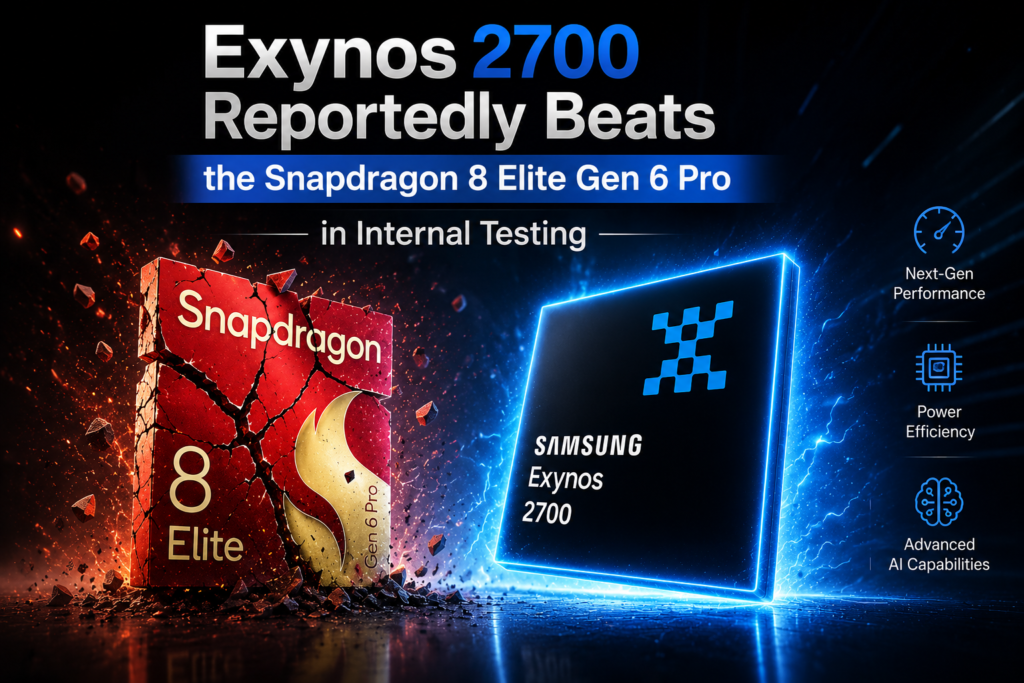
For years, the Exynos-versus-Snapdragon debate has followed a predictable script: Qualcomm wins, and Samsung’s own silicon plays catch-up. A fresh round of leaked internal benchmarks is now suggesting that script might be flipped on its head. According to industry insiders, Samsung’s upcoming Exynos 2700 has outperformed Qualcomm’s next flagship chip, the Snapdragon 8 Elite Gen 6 Pro, across CPU, GPU, NPU and power efficiency testing.
If these numbers hold up outside a controlled lab environment, it could reshape which regions get an Exynos-powered Galaxy S27 next year, and it says a lot about how seriously Samsung is taking its in-house chip division again.

What the Leaked Benchmarks Actually Show
Let’s get the naming sorted first, because Qualcomm has muddied the waters a bit this generation. The company has confirmed there will be two separate Elite-tier chips this cycle: the Snapdragon 8 Elite Gen 6 and the Snapdragon 8 Elite Gen 6 Pro. Both are distinct from the standard, non-Elite Gen 6 chip that will presumably power more affordable flagships. Qualcomm has also confirmed a price increase across its chipset lineup, which becomes relevant later.
Now to the numbers reportedly pulled from Samsung’s internal testing:
- On Geekbench 6.5 multi-core, the Exynos 2700 scored roughly 9.5% higher than the Snapdragon 8 Elite Gen 6 Pro, and about 19% higher than the standard Elite Gen 6.
- On GPU testing, the Exynos chip reportedly edged out the Elite Gen 6 Pro by around 5%.
- Under a constrained 2.5W power limit, the gap widened significantly, with the Exynos GPU reportedly beating the Elite Gen 6 Pro by 22% and the standard Elite Gen 6 by 24%.
- In a simulated real-world usage scenario, the Exynos 2700 reportedly drew 161mA of current compared to 185mA for the Snapdragon 8 Elite Gen 6 Pro, pointing to meaningfully better efficiency.
- On an on-device AI workload using Llama 3.1 8B, the Exynos 2700 reportedly generated responses 18% faster than its Qualcomm counterpart.
It’s worth being upfront about the limitations here. These are internal, first-party benchmarks attributed to anonymous insiders rather than independent lab results, so treat the specific percentages as directional rather than final. Chip performance also tends to shift once real silicon reaches mass production and gets tuned for actual phones, so the numbers that show up in a review unit next year could look different from what’s circulating now.
Why This Matters More Than Usual
Samsung’s chip design arm (LSI) and its mobile phone division (MX) technically operate as separate business units, but MX still has a financial reason to prefer Exynos when the performance is comparable: it can buy flagship Exynos chips more cheaply than flagship Snapdragon chips. With Qualcomm now confirming a price hike on top of that, the incentive to lean on Exynos gets even stronger.
That’s reportedly reflected in how much of Samsung’s own phone lineup already runs on Exynos silicon, with internal data cited by South Korean outlet Maeil Business putting the Exynos share at somewhere between 16% and 18% of Samsung’s phones. Spending on Exynos chips has fluctuated over the years, and this year’s numbers are said to be tracking behind last year’s, meaning MX would need to lean harder into Exynos to catch up.
Put simply: even if the performance were only equal, Samsung would have a cost incentive to use more Exynos chips. A generation where Exynos genuinely leads in some benchmarks makes that decision much easier to justify internally.
What This Could Mean for the Galaxy S27 Lineup
If the Exynos 2700 lives up to these early claims, it increases the odds of Exynos-powered Galaxy S27 units shipping in Korea, across Europe, and potentially in other markets where Samsung has historically alternated between the two chipsets depending on the region. Snapdragon versions would likely still show up in markets like the US and China, where Qualcomm chips have typically been the standard.
There’s also a broader angle here: Samsung has reportedly planned several new foldable devices for next year, and it’s an open question how many of those will run Exynos versus Snapdragon hardware. A strong-performing, power-efficient Exynos chip makes it more viable for Samsung to expand its use into devices beyond the standard Galaxy S line.
The Manufacturing Angle: SF2P and 2nm Production
Part of what’s driving interest in the Exynos 2700 is where it’s reportedly being built. The chip is said to be manufactured on Samsung’s SF2P node, the company’s second-generation 2nm Gate-All-Around process. A competitive, well-reviewed chip built on this node would function as a strong advertisement for Samsung’s foundry business, which has been trying to win over more external customers who currently rely on rival fabs.
In other words, this isn’t just a story about which phone chip is faster. It’s also a signal of whether Samsung’s manufacturing technology is catching up in a market where fabrication capability is just as competitive as chip design itself.

A Reality Check on Leaked Benchmarks
It’s easy to get swept up in leaked numbers, especially when they favor the underdog narrative. But a few things are worth keeping in mind before treating this as settled:
- Internal benchmarks are typically run under ideal conditions and may not reflect how a chip behaves in a retail phone with thermal constraints, software overhead, and real background tasks.
- Companies sometimes leak favorable internal numbers strategically, whether to build hype, negotiate with component partners, or shape public expectations ahead of launch.
- Final clock speeds, binning, and software optimization can all change before the Exynos 2700 or the Snapdragon 8 Elite Gen 6 Pro actually ship inside a phone.
None of that means the leak is inaccurate. It simply means the responsible way to read it is as an early, promising signal rather than a confirmed outcome.
What Pakistani Buyers Should Keep in Mind
Chipset rumors like this one tend to matter most to enthusiasts who track flagship hardware closely, but there’s a practical takeaway for buyers in Pakistan too. Samsung has historically shipped different chip variants of the same Galaxy S phone to different regions, and Pakistan has, at various points, received both Exynos and Snapdragon versions depending on the generation.
If you’re planning to buy into the Galaxy S27 series once it launches, it’s worth checking which chip variant is actually being sold locally before comparing specs or benchmark videos online, since a review based on the Snapdragon version won’t necessarily reflect the experience of an Exynos unit, or vice versa. Buying from authorized retailers and confirming PTA approval status also remains good practice regardless of which chip ends up inside the phone you pick.
The Bigger Picture for the Chip Race
Whether or not the exact percentages hold up, this leak reflects something real: the Exynos-versus-Snapdragon gap has narrowed considerably compared to a few years ago, when Exynos chips were routinely criticized for lagging behind in both performance and efficiency. A genuinely competitive Exynos lineup would be good news for the industry as a whole, since it gives Samsung leverage in future chip negotiations with Qualcomm and gives consumers a reason to care about which variant they’re buying rather than treating it as a lottery.
For more coverage on upcoming Samsung chipsets, Galaxy S27 rumors, and flagship processor comparisons, keep checking back on Phonixy as more details emerge ahead of the official launch.
FAQs
Is the Exynos 2700 officially confirmed to beat the Snapdragon 8 Elite Gen 6 Pro? No. The comparison comes from leaked internal testing attributed to anonymous insiders, not an official announcement from Samsung or Qualcomm.
Which phones will use the Exynos 2700? It’s expected to power at least some Galaxy S27 models, potentially including certain foldables, though the exact regional split hasn’t been confirmed.
Why does Samsung use Exynos chips in some regions and Snapdragon in others? Cost is a major factor, since Samsung’s MX division can reportedly source Exynos chips more cheaply than Snapdragon chips, alongside regional licensing and modem compatibility considerations.
What node is the Exynos 2700 built on? It’s reportedly being manufactured on Samsung’s SF2P process, a second-generation 2nm Gate-All-Around node.
Should Pakistani buyers wait for the Galaxy S27 based on this leak? Not necessarily. It’s still early, and which chip variant actually reaches Pakistan won’t be clear until closer to launch.
Conclusion
The Exynos 2700 leak is one of the more interesting chipset stories of the year, not because the numbers are guaranteed to hold up, but because it hints at a genuinely closer race between Samsung and Qualcomm than we’ve seen in a while. With Qualcomm’s price hikes adding financial pressure on top of the performance question, Samsung has real incentive to push Exynos harder in the next Galaxy generation. Stay tuned to Phonixy for updates as more concrete details and independent benchmarks emerge closer to the Galaxy S27 launch.
Phonixy is a technology-focused platform that keeps you updated on smartphones, gadgets, and the latest mobile industry news in a simple, easy-to-understand way. Whether it’s a new chipset leak or details on an upcoming flagship like the Galaxy S27, Phonixy breaks things down clearly for everyday readers. The platform also covers reviews, comparisons, and industry trends to help you make better decisions before your next phone purchase. Whether you’re a tech enthusiast or just planning your next upgrade, Phonixy offers useful, practical reads. For more smartphone news and updates, keep visiting Phonixy.




Leave a Reply