

Poco has put an end to months of speculation. The company has officially confirmed that the POCO F9 Series will launch globally on September 1, revealing the design and colour options for both models ahead of the event. For a brand that built its reputation on flagship-grade hardware at aggressive prices, this confirmation matters, because the lineup is expected to carry that formula into one of the most competitive years the mid-to-premium smartphone segment has seen.
This article breaks down what Poco has confirmed so far, what leaks suggest about the hardware inside the POCO F9 Series, and what the launch could mean for buyers, including those in Pakistan who typically see these devices arrive months after the initial European rollout.
What Poco Has Confirmed About the POCO F9 Series
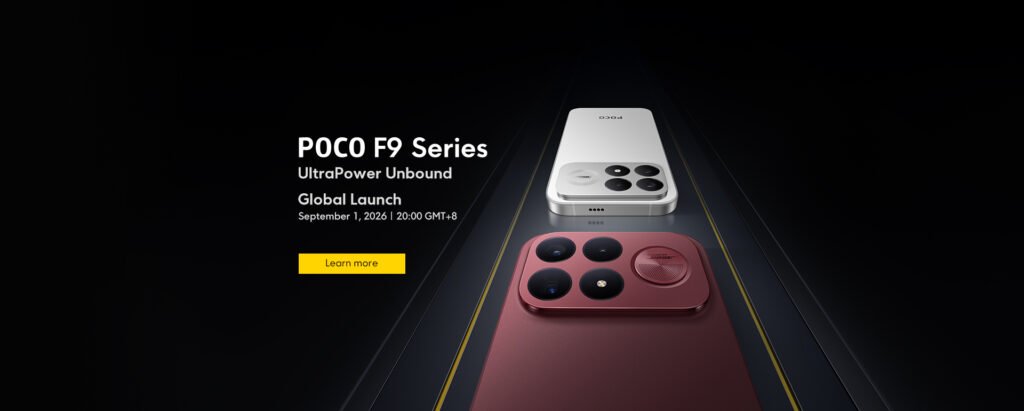
Poco’s own announcement is deliberately narrow in scope. The company has confirmed that the new lineup will consist of two models, the POCO F9 Pro and the POCO F9 Ultra, and that both will be unveiled globally through an online event on September 1. Beyond the launch date and the naming structure, Poco has not published official specifications, pricing, or availability details for any market.
That restraint is fairly typical of how Poco has handled recent launches. The brand tends to release teaser material in stages, confirming design and colours first, then chipset details, then full specifications closer to the event itself. Readers should treat anything beyond the confirmed launch date and colour options as unofficial until Poco says otherwise.
POCO F9 Series Design and Colour Options
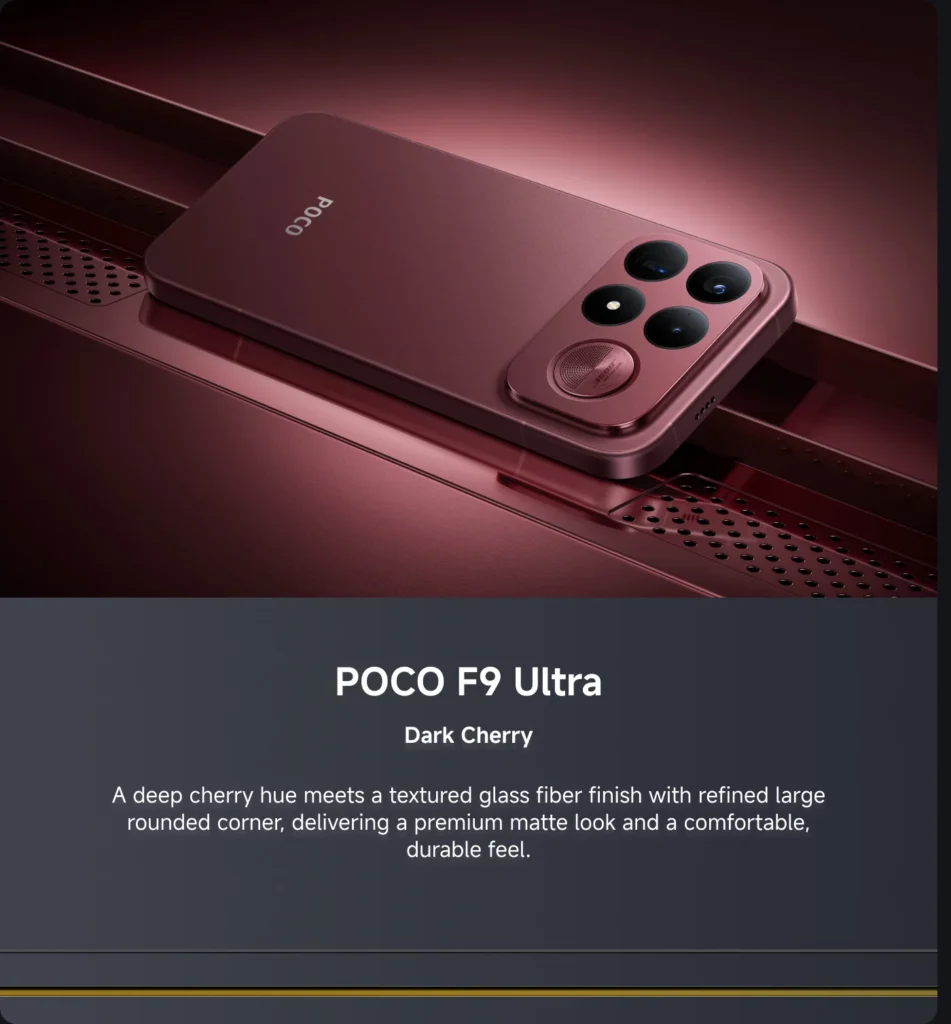
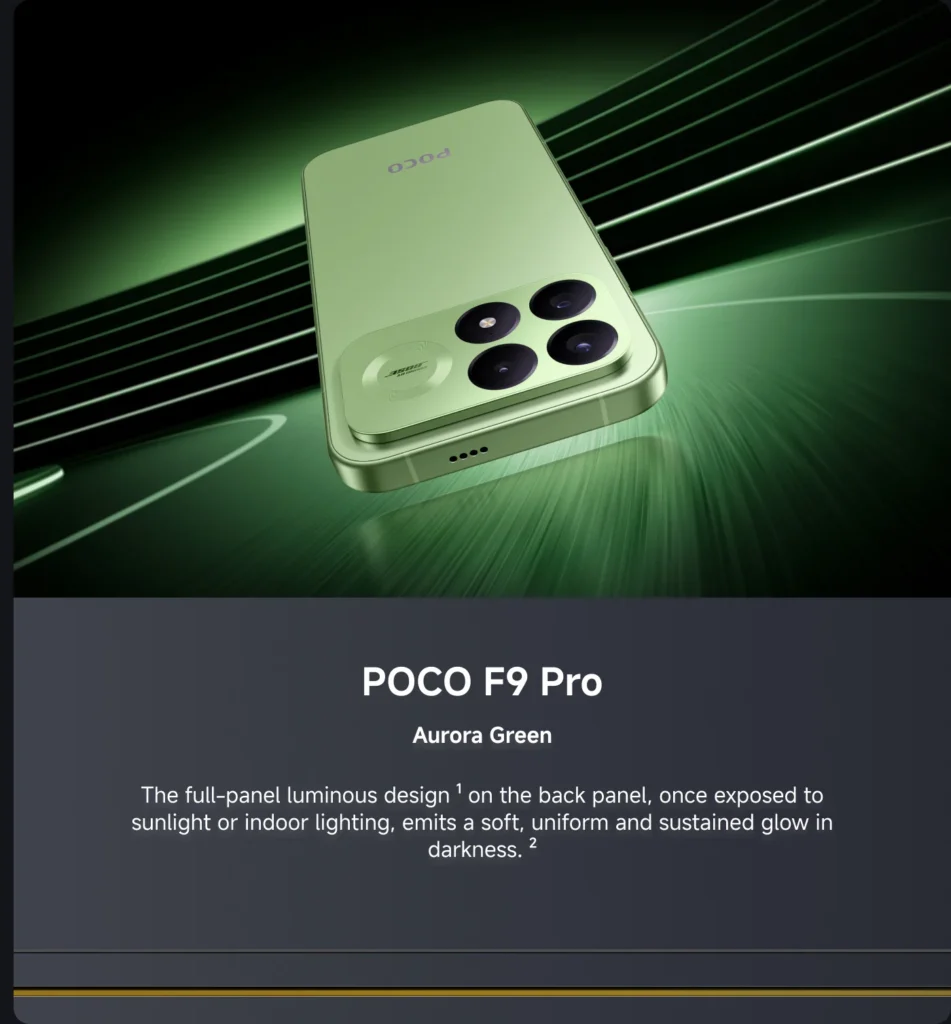
Alongside the launch date, Poco has shown off the first official colourways for the lineup. The F9 Ultra appears in a Dark Cherry finish, while the F9 Pro has been shown in an Aurora Green shade. Both colours lean into the deeper, more saturated tones that have become common across recent flagship-tier phones, a departure from the brighter, more youthful palettes Poco used on earlier F-series models.
Design-wise, official renders point to a large rounded rectangular camera module on the back of both phones, flat display edges, and slim bezels around the screen. Nothing about the confirmed imagery contradicts the leaked renders that have circulated over the past few weeks, which suggests the design is close to final.
Why the POCO F9 Series Is Based on the Redmi K100 Line
Poco’s confirmation quietly settles a question that had already been answered by leaks: the F9 Pro is a rebadged version of the Redmi K100 Pro, and the F9 Ultra is a rebadged version of the Redmi K100 Pro Max, both of which launched in China earlier this month. This is not a new strategy. Poco has built its F-series and X-series lineups on Redmi hardware for several generations, adapting the internals for global markets under its own branding, design language, and software skin.
The practice benefits both brands. Xiaomi gets to test flagship hardware in its home market first, then extend the investment into international sales through Poco without duplicating research and development costs. For buyers, it usually means access to China-first silicon and camera hardware without needing to import a Redmi device directly, though it can also mean some hardware trade-offs, which is exactly what appears to be happening with these two phones.
POCO F9 Series Expected Specifications
Poco has not confirmed detailed specifications yet, so everything in this section comes from leaks, certification filings, and a Geekbench listing that surfaced ahead of the announcement. These details should be treated as reported rather than official until Poco publishes its own spec sheet.
Display and Performance
Leaks point to a 6.59-inch AMOLED panel on the F9 Pro and a larger 6.9-inch AMOLED panel on the F9 Ultra, both reportedly running at a 185Hz refresh rate with peak brightness up to 4,500 nits. Both models are said to be powered by Qualcomm’s Snapdragon 8 Elite Gen 5 chipset, paired with up to 16GB of RAM and storage options that reportedly go as high as 1TB on the Ultra variant.
Camera Systems
Camera leaks describe a 200MP main sensor on both phones, backed by a telephoto lens and an ultrawide camera. The F9 Ultra is tipped to get the more capable setup, with a 50MP telephoto lens offering roughly 5x optical zoom and a 50MP ultrawide sensor, plus an LED notification ring built into the rear camera housing. The F9 Pro is expected to use a smaller 50MP telephoto lens limited to around 2.5x optical zoom and an 8MP ultrawide camera. Both are said to retain a 32MP front-facing camera.
| Spec | POCO F9 Pro (leaked) | POCO F9 Ultra (leaked) |
|---|---|---|
| Display | 6.59-inch AMOLED, 185Hz | 6.9-inch AMOLED, 185Hz |
| Chipset | Snapdragon 8 Elite Gen 5 | Snapdragon 8 Elite Gen 5 |
| RAM / Storage | Up to 16GB / 512GB | Up to 16GB / 1TB |
| Main camera | 200MP with OIS | 200MP with OIS |
| Telephoto | 50MP, ~2.5x optical | 50MP, ~5x optical |
| Ultrawide | 8MP | 50MP |
| Front camera | 32MP | 32MP |
| Charging | 100W wired | 100W wired |
Battery Capacity: The Biggest Change in the POCO F9 Series
The most consistent detail across every leak is also the one buyers are likely to notice most: battery capacity. Both models in the POCO F9 Series are reported to ship with noticeably smaller batteries than their Redmi counterparts, continuing a pattern seen in the previous F8 generation.
| Model | Redmi equivalent battery | Leaked global battery | Approximate reduction |
|---|---|---|---|
| POCO F9 Pro | Redmi K100 Pro — 8,580mAh | 6,330mAh | ~26% smaller |
| POCO F9 Ultra | Redmi K100 Pro Max — 9,070mAh | 8,050mAh | ~11% smaller |
Even with the reduction, an 8,050mAh cell on the F9 Ultra would still be large by global flagship standards, and both phones are expected to retain 100W wired charging. The gap likely comes down to regulatory and thermal considerations that differ between the Chinese and international markets, along with internal component choices Poco makes when adapting Redmi hardware for wider distribution.
Expected POCO F9 Series Pricing in Europe
Poco has not announced official pricing, but leaked European pricing has circulated from multiple sources ahead of the launch. The figures below are unofficial and should be treated as estimates until Poco confirms them at the September 1 event.
| Model | Reported starting price (EUR) | Reported configuration |
|---|---|---|
| POCO F9 Pro | Around €799 | 12GB/256GB (entry variant) |
| POCO F9 Ultra | Around €999 | 12GB/256GB (entry variant) |
If these figures hold, the new lineup would launch at a modest premium over the outgoing F8 series, which opened at $579 for the F8 Pro and $729 for the F8 Ultra. That kind of increase would fit a broader pattern across the industry this year, where component costs, particularly for memory and premium camera sensors, have pushed several manufacturers toward higher launch prices rather than holding the line generation over generation.
What This Could Mean for POCO F9 Series Buyers in Pakistan
Poco has a track record of bringing its F-series phones to Pakistan, typically weeks to a few months after the initial European or Southeast Asian rollout. Official Pakistan pricing for these phones has not been announced and should not be assumed from any of the figures below.
| Model | Reported EUR price | Indicative PKR conversion* |
|---|---|---|
| POCO F9 Pro | ~€799 | ~PKR 259,000 |
| POCO F9 Ultra | ~€999 | ~PKR 324,000 |
*Based on prevailing EUR/PKR exchange rates at the time of writing. This is a raw currency conversion only, not an official or predicted retail price. Local pricing in Pakistan is shaped by import duties, distributor margins, and taxes, and typically lands well above a simple currency conversion of the European price.
Buyers in Pakistan considering the POCO F9 Series should wait for an official regional announcement before making a purchase decision, compare listed specifications carefully against the Redmi K100 originals, confirm whether a unit is being sold through an authorised local retailer, and check the warranty terms that come with it, since grey-market imports of Poco and Redmi devices are common in the local market and often carry no local warranty coverage.
How the POCO F9 Series Compares to the POCO F8 Series
This new lineup succeeds last year’s F8 Pro and F8 Ultra, which launched globally in November 2025 as rebadged versions of the Redmi K90 and K90 Pro Max. Comparing the two generations, at least based on current leaks, points to meaningful gains in display refresh rate, camera resolution, and raw battery capacity, alongside a price increase that tracks those upgrades.
| Metric | POCO F8 Series (2025) | POCO F9 Series (2026, leaked) |
|---|---|---|
| Top chipset | Snapdragon 8 Elite Gen 5 | Snapdragon 8 Elite Gen 5 |
| Ultra battery | 6,500mAh | 8,050mAh (leaked) |
| Pro battery | 6,210mAh | 6,330mAh (leaked) |
| Ultra starting price | $729 | ~€999 (leaked) |
| Pro starting price | $579 | ~€799 (leaked) |
| Main camera | 50MP triple setup | 200MP main sensor (leaked) |
The jump to a 200MP main sensor stands out as the clearest generational upgrade, assuming the leaked camera details hold up once Poco confirms the official specification sheet.
Industry Perspective: Why Rebadging Works for the POCO F9 Series
From a technology journalism standpoint, these phones are a useful case study in how Xiaomi’s sub-brand strategy functions. Redmi’s K-series has effectively become Xiaomi’s proving ground for flagship silicon and camera hardware in China, while Poco handles the international rollout under a separate identity aimed at performance-focused buyers who care more about chipset, display, and battery than brand prestige.
This approach lets Poco compete against far larger flagship budgets from Samsung and Apple without carrying the same research and development overhead, since much of that cost has already been absorbed by the Redmi launch. The trade-off, as the battery figures show, is that global variants rarely arrive as a one-to-one match with their Chinese counterparts. Manufacturers routinely adjust battery capacity, charging hardware, and sometimes network band support to meet different regulatory environments and to manage cost across markets with different price sensitivity.
What Could Happen Next for the POCO F9 Series
With the launch date locked in for September 1, the next several days should bring a steady stream of official teasers from Poco covering chipset confirmation, camera details, and eventually full pricing across key markets. Based on how the F8 series rollout played out last year, a staggered regional launch is likely, with European and Southeast Asian availability arriving close to the global event and other markets, including Pakistan and India, following afterward.
Whether the leaked pricing holds will depend on component costs closer to launch, competitive pressure from rival flagship-killers, and how aggressively Poco wants to position the new lineup against alternatives from Realme, OnePlus, and Redmi’s own online storefronts. None of this is confirmed, and readers should treat any pricing or specification detail not directly attributed to Poco as speculative until the September 1 event.
About Phonixy
Phonixy is a technology-focused platform that covers smartphones, consumer gadgets, and the industry developments that shape what ends up on store shelves and price lists. From launch coverage like this breakdown of the POCO F9 Series to hands-on impressions, buying guides, and market analysis, Phonixy aims to give readers a clear, dependable picture of where mobile technology is headed. Readers who want to keep track of upcoming launches, price changes, and product comparisons can find ongoing coverage at phonixy.com.
bn bFrequently Asked Questions
When will the POCO F9 Series launch globally? Poco has confirmed a global online launch event for September 1, covering both the F9 Pro and F9 Ultra.
What colours will the F9 Pro and F9 Ultra come in? Poco has shown the F9 Ultra in Dark Cherry and the F9 Pro in Aurora Green. Additional colour options have not been confirmed.
Are the F9 Pro and F9 Ultra rebadged Redmi phones? Yes. Leaks and industry reporting indicate the F9 Pro is based on the Redmi K100 Pro, and the F9 Ultra is based on the Redmi K100 Pro Max, both of which already launched in China.
Will the new lineup have smaller batteries than the Redmi K100 line? Leaks suggest yes. The F9 Pro is tipped at 6,330mAh versus the Redmi K100 Pro’s 8,580mAh, and the F9 Ultra is tipped at 8,050mAh versus the Redmi K100 Pro Max’s 9,070mAh.
Has Poco confirmed official pricing yet? No. Reported figures of roughly €799 for the F9 Pro and €999 for the F9 Ultra come from unofficial leaks, not Poco’s own announcements.
When could these phones launch in Pakistan? Poco has not announced a Pakistan launch date. Based on past F-series rollouts, a local launch would likely follow the global event by several weeks to a few months.
What chipset do the new models reportedly use? Leaks point to the Snapdragon 8 Elite Gen 5 across both models, though Poco has not officially confirmed this.
Should I buy a POCO F8 series phone now or wait for the new lineup? That depends on availability and pricing in your market. Buyers who need a phone immediately can consider the F8 series, while those who can wait until after September 1 will have official specifications and pricing to compare against.
How does the camera on the new models compare to the previous generation? Leaked details point to a 200MP main sensor on both new models, a step up from the 50MP triple-camera setup on the POCO F8 series, though this remains unconfirmed until Poco’s official reveal.
Is the POCO F9 Ultra the same as the POCO F9 Pro? No. The F9 Ultra is expected to have a larger display, bigger battery, and more capable telephoto and ultrawide cameras than the F9 Pro, positioning it as the higher-tier model in the lineup.
Conclusion
Poco’s confirmation of the POCO F9 Series brings months of leaks into official focus, even if the company has deliberately held back full specifications and pricing until September 1. What is confirmed, the launch date, the two-model lineup, and the Dark Cherry and Aurora Green colourways, lines up closely with what leaks have already reported, lending weight to the unofficial details about battery capacity, cameras, and pricing that have circulated over the past few weeks.
For buyers weighing whether to wait for the POCO F9 Series, the smart move is to hold off on any purchase decision until Poco publishes official specifications and regional pricing. Readers in Pakistan in particular should treat any pricing figures ahead of an official local announcement as estimates rather than facts. Phonixy will continue tracking the launch as more details emerge ahead of and after the September 1 event, so check back at phonixy.com for updates, specifications, and pricing coverage as soon as they’re confirmed.




Leave a Reply