
Budget smartphone shoppers just got some unwelcome news. Samsung has quietly raised prices across several of its entry-level phones, and this Samsung Galaxy Price Hike is already reshaping how much buyers pay for devices that used to sit comfortably in the affordable category. If you have been eyeing a Galaxy A, F, or M series phone, the timing of your purchase suddenly matters a lot more than it did a few months ago.
This report breaks down exactly which models are affected, why Samsung made this move, and what Pakistani buyers should expect as the ripple effects of this price increase spread beyond India.
Why Samsung Raised Prices on Its Budget Phones
According to GSMArena, Samsung India has increased prices on its lowest-tier devices, specifically the 06, 07, and 17 model numbers across the Galaxy A, F, and M series. Both 4G and 5G variants are affected, and the change was not accompanied by any hardware upgrade or new feature. The phones are simply costing more than they did before.
Industry analysts had been warning about this for months. Entry-level smartphones are the most exposed to rising component costs because their profit margins are thin to begin with, leaving very little room to absorb higher parts pricing without passing it on to the customer. That warning has now played out, and the result is this Samsung Galaxy Price Hike hitting the exact segment analysts predicted.
Which Models Are Affected
The current Samsung Galaxy Price Hike touches a wide slice of Samsung’s budget lineup. Reports through 2026 point to repeated increases on the following model families:
- Galaxy A06 and Galaxy A06 5G
- Galaxy A07 and Galaxy A07 5G
- Galaxy A17 and Galaxy A17 5G
- Galaxy F06 and Galaxy F36
- Galaxy F70e
- Galaxy M06 and Galaxy M06 5G
- Galaxy M17 and Galaxy M17e
- Galaxy M36
Some outlets tracking the increases noted that the newest revision pushed the top-specced Galaxy A17 5G past the ₹30,000 mark in India, a price point that feels steep for what the phone offers on paper. That single detail captures the mood around this Samsung Galaxy Price Hike: phones once marketed as accessible are drifting toward mid-range pricing without a matching upgrade in specifications.
Old vs New Pricing: How Much Has Changed
Multiple price revisions have landed throughout 2026, and they have not always been uniform. Some updates added a flat amount across the board, while others varied by model and storage configuration. The table below summarizes the pattern reported across India, where this round of increases began.
| Model | Approximate Old Price (India) | Approximate New Price (India) | Reported Increase |
|---|---|---|---|
| Galaxy M06 (4/64GB) | ₹10,499 | ₹12,499 | ₹2,000 |
| Galaxy F06 (4/64GB) | ₹10,999 | ₹12,499 | ₹1,500 |
| Galaxy M36 (6/128GB) | ₹19,999 | ₹21,999 | ₹2,000 |
| Galaxy F36 (8/256GB) | ₹25,999 | ₹27,999 | ₹2,000 |
| Galaxy M17e (4/64GB) | ₹Varies | ₹49,999 equivalent tier | ₹1,000 |
| Galaxy A17 5G (top variant) | Below ₹30,000 | Above ₹30,000 | ₹1,000–2,000 |
Note: figures are drawn from multiple 2026 pricing reports and reflect approximate India market values at the time of each revision. Exact retail prices vary by retailer, city, and ongoing promotions.
The Real Reason Behind the Increases
The underlying driver of this Samsung Galaxy Price Hike is not unique to Samsung. Memory chip prices, specifically RAM and storage components, have climbed sharply because global demand for AI infrastructure and data center hardware has pulled supply away from consumer electronics. When memory makers prioritize high-margin server and AI chip orders, phone manufacturers pay more for the same RAM and storage modules that used to be inexpensive.
Budget phones feel this first. A flagship device can absorb a few dollars of extra component cost inside a price tag that already runs into hundreds of dollars. A phone that used to sell for the equivalent of a hundred dollars has almost no cushion, so even a small rise in memory pricing forces a visible increase at checkout. That is precisely why this wave of increases has concentrated on the 06, 07, and 17 series rather than Samsung’s premium Galaxy S lineup, some of which has reportedly seen prices hold steady or even drop in certain markets.
Samsung has not issued a detailed public explanation for each individual revision, but the pattern lines up with what component suppliers and market analysts have been saying since early 2026: memory shortages are reshaping smartphone pricing across the entire industry, not just at Samsung.
Could This Price Hike Reach Pakistan Too
Pakistani buyers naturally want to know whether this Samsung Galaxy Price Hike will cross over from India. While Samsung Pakistan has not announced a formal, unified price revision tied directly to the Indian changes, a few factors make it worth watching closely.
First, the root cause is global. Memory and storage shortages affect every market where Samsung sources components internationally, not just India. Second, Pakistan’s mobile pricing already carries added sensitivity to currency movement, import duties, and PTA taxation, so any rise in Samsung’s base component costs tends to filter through eventually, even if the timing and size of the adjustment differ from India’s. Third, Samsung has a track record of adjusting regional pricing in stages rather than all at once, which means a Pakistani version of this Samsung Galaxy Price Hike could arrive gradually over several months instead of as a single dramatic jump.
For now, buyers in Pakistan are seeing steady, sometimes fluctuating, prices across retailers rather than one official nationwide increase. That could change as Samsung’s supply costs continue to climb globally.
[Image Here: Samsung Pakistan Price List Budget Series]
Current Samsung Galaxy A, F and M Series Prices in Pakistan
To give local context, here is an approximate snapshot of retail pricing for the affected series inside Pakistan. These are market estimates in PKR and can vary by city, retailer, and ongoing promotions.
| Model | Approximate Price in Pakistan (PKR) |
|---|---|
| Galaxy A06 (4/64GB) | Rs. 27,000 – 33,000 |
| Galaxy A06 (6/128GB) | Rs. 38,000 – 45,000 |
| Galaxy A07 (4/64GB) | Rs. 28,000 – 36,000 |
| Galaxy A07 (6/128GB) | Rs. 39,000 – 50,000 |
| Galaxy A17 4G (128GB) | Rs. 52,000 – 63,000 |
| Galaxy A17 5G (128GB) | Rs. 57,000 – 70,000 |
| Galaxy A17 5G (256GB) | Rs. 63,000 – 87,000 |
| Galaxy M17e | Rs. 45,000 – 50,000 |
| Galaxy F70e | Rs. 42,000 – 48,000 |
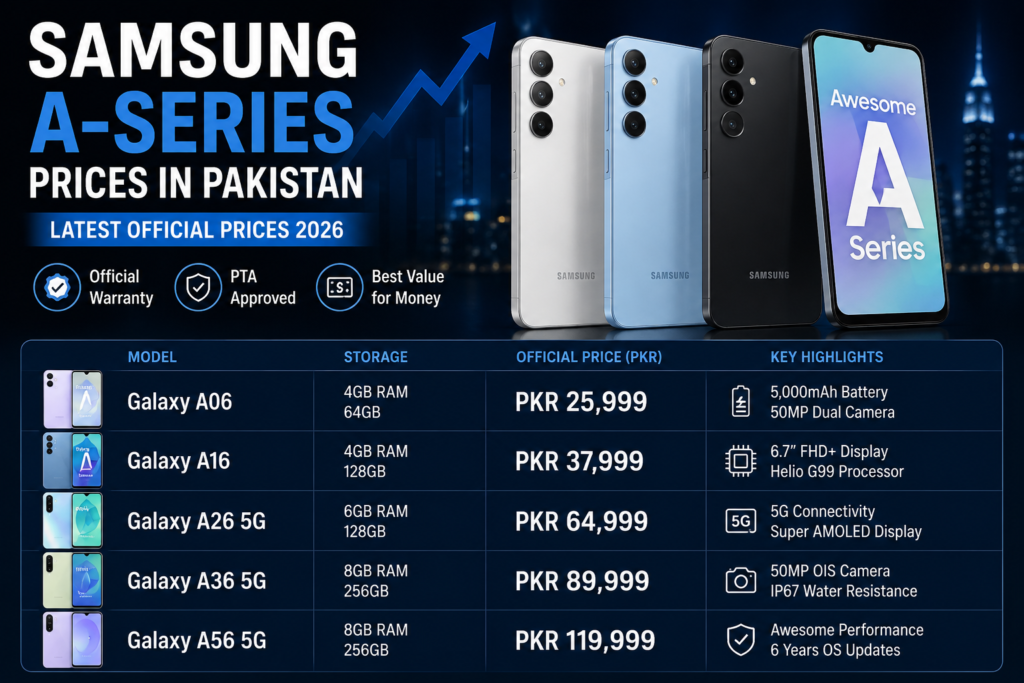
Pakistan pricing estimate: these figures reflect the wider retail range reported across multiple local sellers in mid-2026 and are meant as a general guide rather than an official Samsung price list.
How This Compares to Other Regions
India is not the only market where component costs are showing up at checkout. Reports out of Indonesia describe the Galaxy A07 4/64GB variant rising from roughly 1.3 million to 2.3 million rupiah, a jump far steeper than what India has experienced so far. That comparison matters because it shows this Samsung Galaxy Price Hike is not a one-off regional decision but part of a broader, global repricing driven by memory chip economics. Buyers everywhere, including in Pakistan, are effectively watching the same underlying cost pressure play out at different speeds.
Pros and Cons: Buying Now vs Waiting
| Buy Now | Wait and Watch |
|---|---|
| Pros: Lock in today’s price before further increases | Pros: Possible discounts during sales events or new model launches |
| Pros: Avoid missing out on current stock and color options | Pros: More time to compare alternatives from Xiaomi, Infinix, and Vivo |
| Cons: Prices could still be adjusted later in the same model’s lifecycle | Cons: Memory shortages suggest prices are more likely to rise than fall |
| Cons: Newer variants may launch with similar or higher pricing | Cons: Waiting could mean paying more for the exact same specifications |
Key Features of the Affected Models
| Series | Typical Chipset | RAM/Storage Range | Display | Battery |
|---|---|---|---|---|
| Galaxy A06 / A07 | MediaTek Helio G85/G99 | 4-8GB / 64-256GB | 6.7″ PLS LCD | 5000mAh |
| Galaxy A17 (4G/5G) | Helio G99 / Exynos 1330 | 6-8GB / 128-256GB | 6.7″ Super AMOLED, 90-120Hz | 5000mAh |
| Galaxy M06 / M17 series | Exynos 1330 / MediaTek | 4-8GB / 64-256GB | 6.7″ PLS LCD/AMOLED | 5000mAh |
| Galaxy F06 / F36 / F70e | Exynos / MediaTek | 4-8GB / 64-256GB | 6.6-6.7″ LCD/AMOLED | 5000-6000mAh |
Should You Buy Before Prices Rise Further
| Buyer Type | Recommendation |
|---|---|
| Need a phone urgently | Buy now, since this Samsung Galaxy Price Hike shows an upward trend rather than a temporary spike |
| Flexible on timing | Compare current Pakistan pricing against upcoming sales events before deciding |
| Considering alternatives | Weigh similarly priced Xiaomi, Infinix, or Vivo models, which face the same memory cost pressure |
| Prioritizing long-term value | Favor higher RAM and storage variants now, since future price gaps between tiers may widen |
What This Means for the Budget Smartphone Market
The broader story behind this Samsung Galaxy Price Hike is that the definition of a “budget phone” is quietly shifting. A few years ago, a capable 5G device could be found comfortably under ten thousand rupees in India, and Pakistani buyers enjoyed similarly accessible entry points. Today, several of those same model tiers are edging past that threshold, not because the phones improved dramatically, but because the components inside them cost more to manufacture.
Samsung is not acting in isolation either. Reports describing similar increases at other brands suggest this pricing shift is one visible symptom of an industry-wide adjustment. Analysts expect memory prices to remain elevated at least into 2027 as AI-related demand continues to outpace chip production capacity, which means further price movement across budget smartphones, Samsung included, is a realistic possibility rather than a worst-case scenario.
For everyday buyers, the practical takeaway is straightforward: the window for grabbing an entry-level Galaxy phone at last year’s pricing is closing, and it is closing across more markets than just India.
Retailers in Pakistan are also watching import costs and currency movement alongside global component pricing, so even without one official Samsung announcement, local sellers may adjust their own margins over time. Buyers who track listings across a few trusted retailers rather than relying on a single store tend to spot these shifts earliest.
[Image Here: Budget Smartphone Market Trend 2026]
Frequently Asked Questions
1. What exactly is the Samsung Galaxy Price Hike about? It refers to a series of price increases Samsung has applied to its entry-level Galaxy A, F, and M series phones through 2026, primarily affecting the 06, 07, and 17 model numbers.
2. Which countries are affected by this price increase? India has seen the most documented increases so far, with similar cost pressure also reported in markets like Indonesia. Pakistan has not had one official unified announcement, but the same global component costs apply here too.
3. Why did Samsung increase prices without adding new features? The increases are tied to rising RAM and storage component costs rather than product upgrades, which is why specifications have largely stayed the same while prices moved up.
4. Has the Samsung Galaxy Price Hike affected flagship models too? Reports suggest flagship Galaxy S series pricing has been comparatively stable, and in some cases even reduced, while the pressure has concentrated on budget and entry-level devices.
5. How much more expensive have these phones become? Reported increases range from roughly ₹1,000 to ₹2,000 per revision in India, though cumulative increases across multiple 2026 revisions add up to a more noticeable difference.
6. Will Samsung Pakistan officially confirm a price increase? There is no single confirmed nationwide announcement yet, though retail prices in Pakistan already fluctuate and could adjust further as global memory costs continue rising.
7. Should I buy a Galaxy A, F, or M series phone right now? If you need a phone soon, buying now avoids the risk of paying more later, since current trends point toward further increases rather than price drops.
8. Are other smartphone brands facing the same pressure? Yes. The RAM and storage shortage is an industry-wide issue, and other manufacturers are expected to face similar cost pressure on their budget lineups.
9. How long is this price pressure expected to last? Industry estimates suggest memory shortages could persist into 2027, meaning further price adjustments across budget smartphones remain possible.
10. Where can I check the latest Samsung Galaxy prices in Pakistan? Local retailer listings and Samsung’s official Pakistan website are the most reliable sources, since prices can shift between cities and sellers even without a formal announcement.
Conclusion
The Samsung Galaxy Price Hike is a clear signal that budget smartphones are no longer insulated from the global component crunch shaping the wider tech industry. Entry-level Galaxy A, F, and M series buyers in India are already feeling it, and the same cost pressures are likely to influence pricing in Pakistan over time, even without one single official announcement. For buyers currently weighing a purchase, the safest approach is to track prices closely, compare current Pakistan retail listings, and avoid assuming today’s price will still be available a few months from now.
For the latest updates on Samsung Galaxy pricing, upcoming smartphone launches, and honest buying advice tailored for Pakistani readers, Phonixy will keep tracking this Samsung Galaxy Price Hike and every other major shift in the mobile market. Stay with Phonixy for timely, accurate coverage that helps you make smarter smartphone decisions.




Leave a Reply