
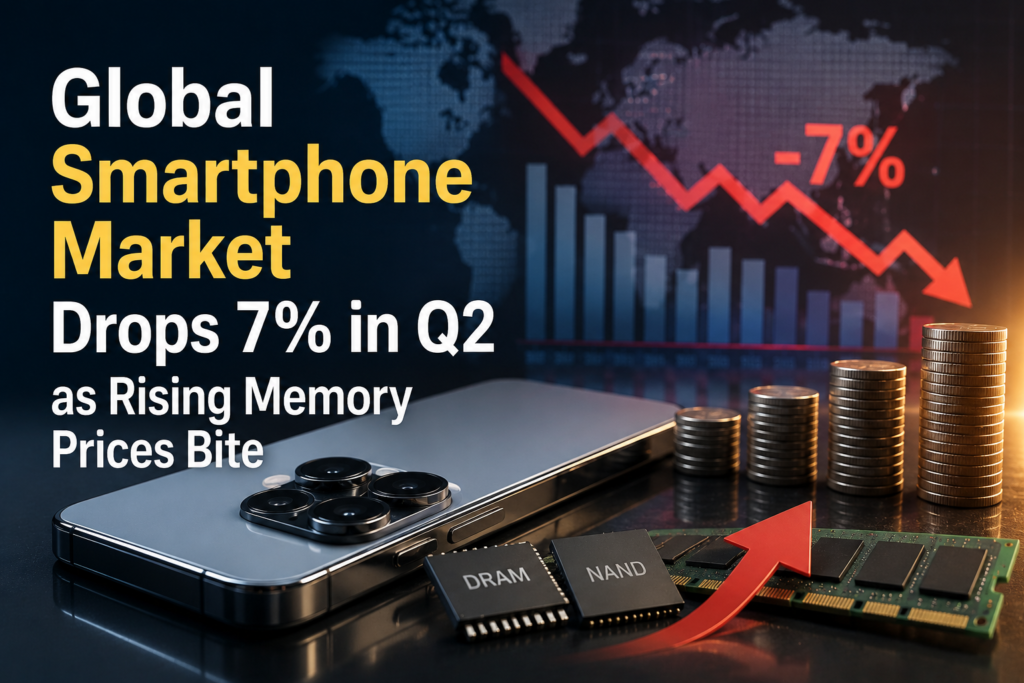
The global smartphone market just had one of its weaker quarters in recent memory, and unusually, the cause has little to do with fading interest in new phones. Worldwide shipments fell 7% in the second quarter of 2026 compared to the same period last year, and industry analysts are pointing to a specific culprit: the rising cost of memory chips.

Smartphone slowdowns are usually blamed on market saturation or cautious spending. This time the story is more specific. A global shortage of memory components has pushed manufacturing costs higher, and those costs are starting to show up in retail prices. That matters for anyone connected to the smartphone market, because it shows hardware economics, not just consumer taste, are now shaping how phones get priced and sold.
This article breaks down what happened in Q2, why memory prices are climbing, how that pressure travels from factories to store shelves, and what it could mean for buyers here in Pakistan.
What Happened to the Smartphone Market in Q2?
According to a report from CCS Insight, published via FDM, the smartphone market shrank 7% year-over-year in Q2 2026 and fell 3% compared to Q1. The same report forecasts a 12% decline in global shipments for the full year, a notable downgrade for an industry that had recently shown signs of steadying.
It helps to be precise about what these numbers measure. Shipment data tracks devices sent from manufacturers to retailers, not necessarily units sold to end users in real time. A decline can reflect manufacturers trimming production, retailers ordering cautiously, or genuinely softer demand. Analysts point to a mix of all three, tied back largely to memory costs rising faster than the smartphone market can comfortably absorb.
The decline wasn’t even across regions. Europe and North America saw relatively modest, low single-digit drops, while emerging markets, where buyers are far more sensitive to price increases, recorded steeper declines. That pattern tracks with basic economics: in price-sensitive regions, even a modest increase can be enough to delay a purchase.
One segment is actually growing. Used and refurbished phone sales rose around 3% year-over-year in Q2, and CCS Insight expects that category to grow close to 9% for the full year. That’s telling: when new shipments fall while second-hand demand climbs, interest in smartphones hasn’t disappeared, buyers are simply being pushed toward cheaper alternatives.
Why Are Rising Memory Prices a Problem?
Every modern phone depends on two types of memory. RAM handles the active workload, keeping apps responsive and multitasking smooth. NAND flash storage holds permanent data, including the operating system, apps, and files. Both come from a handful of global suppliers, including Samsung, SK Hynix, and Micron, whose pricing decisions ripple straight into the smartphone market.
When supply tightens, whether from factory capacity limits or competing demand from other industries, prices for these chips can climb quickly, and manufacturers have few alternative sources to turn to. That’s essentially what has unfolded through 2026. Strong demand for memory from AI servers and data centers has been competing directly with mobile devices for the same limited manufacturing capacity. Expanding chip fabrication takes years and enormous investment, so suppliers can’t simply increase output overnight, and the resulting imbalance pushes prices upward for everyone competing in the smartphone market.
Memory also isn’t a component brands can easily downgrade without users noticing. Too little RAM makes multitasking sluggish; too little storage frustrates people almost immediately. That makes memory one of the least flexible line items in a phone’s bill of materials, and it’s a big reason rising costs here ripple so widely through the smartphone market.
How Memory Costs Affect Smartphone market Prices
Component costs and retail prices are related, but not in a simple one-to-one way. Manufacturers have several options before a price hike reaches a store shelf, and the mix they choose depends on scale, supplier contracts, and available margin.
The same report found new phones were roughly 13% more expensive in Q2 2026 than in Q1, with further increases expected through the second half of the year. That sharp move helps explain why the smartphone market softened even as underlying interest in phones stayed fairly steady.
Common responses include:
- Raising retail prices directly, the most visible option.
- Trimming promotional discounts, so the listed price holds while the effective price paid rises.
- Adjusting storage tiers, such as making a higher-capacity variant the new base model.
- Switching component suppliers or specifications to improve unit cost.
- Reshuffling product lineups, delaying or repositioning planned models.
- Absorbing part of the cost temporarily, mainly among larger, better-margined brands.
Manufacturers rarely pass the full increase to buyers in one move, since that risks losing sales to a competitor willing to absorb costs a little longer. Most blend several tactics at once, which is why the effects tend to surface gradually rather than as one dramatic jump.
Which Smartphones Could Be Affected Most?
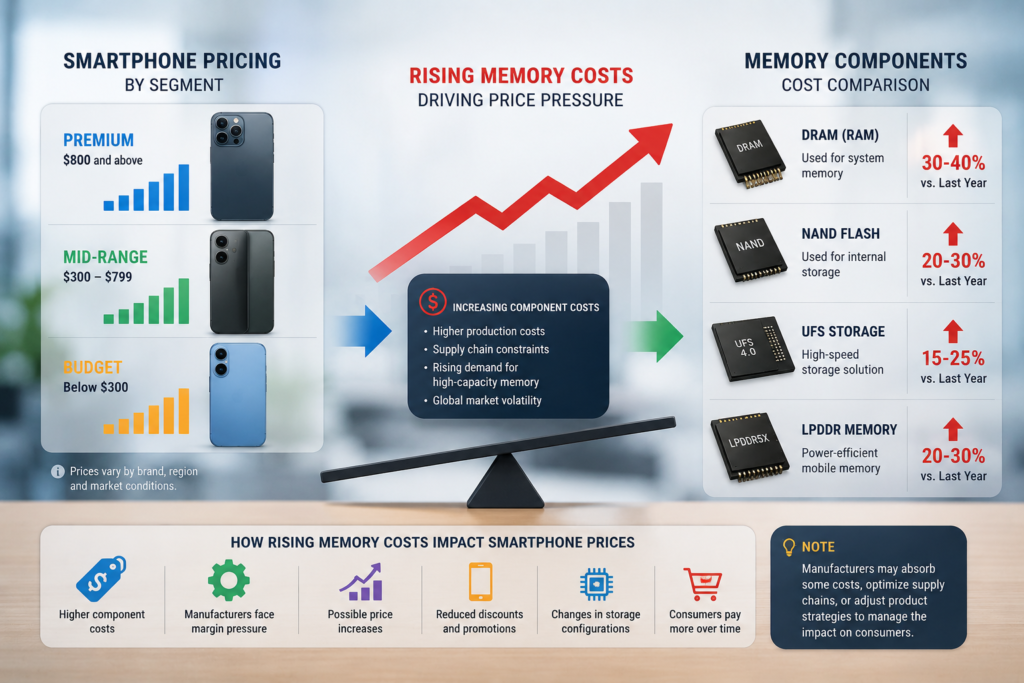
The impact of rising memory costs varies considerably across the smartphone market, depending on price tier.
Budget Smartphones
Entry-level phones are the most exposed, since memory and storage make up a disproportionately large share of their total build cost. Budget makers have far less room to absorb a 13% jump in memory pricing than premium brands do, so price increases, thinner discounts, or trimmed specifications are all realistic outcomes. Buyers in this tier are also the most price-sensitive, so even small increases can influence purchase decisions.
Mid-Range Smartphones
This is where the most visible trade-offs tend to show up. Mid-range brands often compete by offering generous RAM and storage at a competitive price, so when memory gets pricier, they may need to rebalance, holding prices steady while trimming base storage, or nudging prices up slightly while keeping specifications intact. Expect closer scrutiny of value-for-money positioning here over the coming quarters.
Premium Smartphones
Flagship devices generally have more room to absorb rising costs, thanks to healthier margins and less price-sensitive buyers. Still, flagships typically ship with more RAM and larger storage tiers, so the absolute cost increase per unit can be larger even if it’s a smaller share of the total price. Premium brands may hold headline prices steady while quietly trimming bundled accessories or promotional frequency instead.
What This Means for Smartphone market Buyers
For everyday consumers, the effects of a tighter smartphone market are likely to unfold gradually. Prices for new devices could keep drifting upward over the next few quarters if memory supply stays tight. Discounts and seasonal deals may become less generous, since manufacturers have less margin to give away. Some brands might quietly adjust RAM and storage configurations, shipping a device with a different base memory tier than its predecessor at a similar price. Planned budget or mid-range launches could also shift timing if the cost math doesn’t work at the intended price point.
There’s a behavioral shift worth watching too. As new phones get pricier, more buyers may stretch their upgrade cycles or lean toward certified refurbished options, consistent with growth already visible in that segment. None of this guarantees every buyer pays more immediately; outcomes vary by brand, region, and model, and timing a purchase around genuine sales events remains a sensible approach.
How Smartphone Manufacturers May Respond
Manufacturers have tools beyond pricing, and larger companies generally have more of them. Firms with long-term, high-volume supplier contracts are typically better insulated from short-term spikes than smaller brands buying on the spot market, which is one reason the biggest names in the smartphone market may weather this period more comfortably than smaller regional players.
Inventory strategy matters too. Some manufacturers build component stockpiles when prices are lower, or diversify across multiple suppliers to reduce dependence on any single source. Product segmentation is another lever: a brand might protect flagship specifications while making more visible adjustments to budget and mid-range models, where cost pressure is felt most acutely, or simply slow the pace of new releases to extend an existing lineup’s life. How any individual company responds ultimately depends on its size, supplier relationships, margins, and how central price competitiveness is to its brand identity.
Impact on the Global Mobile Industry
This episode highlights how interconnected the technology industry has become. A shortage rooted largely in AI infrastructure and data-center demand has rippled outward into mobile devices, a reminder that the smartphone market doesn’t operate in isolation from the broader semiconductor ecosystem.
For component suppliers, sustained high memory prices could mean stronger near-term revenue but also a risk of demand destruction if buyers pull back sharply. For manufacturers, prolonged cost pressure could squeeze smaller players harder than larger ones, potentially accelerating consolidation in a smartphone market already dominated by a handful of major brands. Retailers, meanwhile, may need to give more shelf space to certified refurbished programs as second-hand demand grows.
There’s also a possible knock-on effect for product launches: less room for aggressive feature upgrades in the short term, with competitive intensity shifting toward value engineering and software experience rather than simply piling on more RAM and storage each generation. None of these outcomes are guaranteed; they’re reasonable directions based on current conditions, not confirmed developments.
What Could Happen Next?
Several factors will shape how this plays out through 2026. Memory supply is the biggest variable: if chipmakers expand capacity or AI-driven demand eases, prices could stabilize sooner than expected. If the shortage persists, the 12% annual decline forecast by CCS Insight could prove optimistic rather than pessimistic.
In regions already dealing with inflation, added price increases could compound existing affordability concerns, while already-lengthening replacement cycles could stretch further. It’s too early to say precisely how pricing or shipment volumes will look by year-end, but the smartphone market is clearly adjusting to a costlier component environment, and the coming quarters should clarify whether this is a temporary shock or a lasting shift.
What Pakistani Smartphone Buyers Should Know
Global memory shortages might feel distant from everyday phone shopping in Pakistan, but component costs eventually work their way into local pricing, especially since most brands sold here import devices or parts priced in US dollars. Local retail pricing and even specifications offered in Pakistan-market variants can shift over time, sometimes with a lag of a few weeks or months.
A few habits are worth keeping in mind:
- Compare specifications rather than assuming a familiar name means the best value this time.
- Check official pricing from authorized retailers before relying on unverified figures.
- Think honestly about how much RAM and storage you actually need.
- Watch for genuine discount periods rather than assuming every “sale” is a real cut.
- Buy from authorized retailers to ensure proper warranty coverage.
- Understand what your warranty covers, particularly for repairs involving memory components.
Readers who want to track how these global shifts affect local pricing and availability can follow ongoing phone launch and price coverage on Phonixy.
Technology Industry Perspective
What this quarter really shows is how tightly balanced smartphone manufacturing economics have become. Every device has to satisfy competing pressures at once: hardware costs tied to global component markets, consumer expectations that rarely tolerate a step backward in specifications, margins that investors watch closely, and a competitive landscape where a rival brand is often one price cut away from winning over a hesitant buyer.
Memory pricing is a sharp example of this balancing act because it’s essential and largely non-negotiable at a minimum viable specification. A brand can trim camera hardware or build materials without most users noticing right away, but compromising too far on RAM or storage produces a noticeably worse day-to-day experience, which is why manufacturers are reluctant to cut corners there even under cost pressure.
The global Smartphone Market has entered a challenging phase, with new data showing a sharp 7% decline in Q2 2026 shipments compared to last year. This slowdown in the Smartphone Market is being driven largely by rising memory chip prices, which pushed new phone costs up 13% in just one quarter. Analysts tracking the Smartphone Market note that emerging regions, where buyers are more price-sensitive, felt the steepest impact, while developed markets like Europe and North America saw only modest declines.
As manufacturers navigate this pressure, the Smartphone Market is also seeing a notable shift toward second-hand and refurbished devices, as budget-conscious consumers look for alternatives to pricier new releases. Going forward, how memory supply and component costs evolve will likely determine whether this Smartphone Market slowdown proves temporary or signals a longer-term shift in how phones are priced and sold worldwide.
This is also why a shift like the one seen in Q2 tends to ripple through the entire smartphone market rather than staying contained to one brand or price tier. When a foundational input becomes pricier industry-wide, nearly every manufacturer has to adjust, even if the specific choices differ.
About Phonixy
Phonixy is a technology-focused platform covering smartphones, consumer gadgets, and the broader trends shaping the mobile industry. From new phone launches and reviews to pricing updates and explainers on developments like this one, Phonixy aims to give readers a clear, well-researched picture of what’s happening in tech without unnecessary hype. Readers can find ongoing smartphone market news and buying guidance at phonixy
Frequently Asked Questions
Why did the smartphone market decline in Q2? Global shipments fell 7% year-over-year in Q2 2026, largely because rising memory component prices pushed up the cost of new devices, prompting some buyers to delay purchases or turn to second-hand alternatives instead.
How do rising memory prices affect smartphones? RAM and NAND storage are essential, hard-to-substitute components in every phone. When memory supply tightens and prices rise, manufacturing costs increase industry-wide, since almost every device depends on the same limited component sources.
Will smartphone prices increase because of memory costs? Prices for new devices already rose roughly 13% between Q1 and Q2 2026, with further increases expected through the rest of the year. Manufacturers use several strategies beyond direct price hikes, so the size of any increase can vary by brand and model.
Which smartphone segment could be affected most? Within the smartphone market, budget phones tend to be the most sensitive, since memory represents a larger share of their overall cost. Mid-range devices may see specification adjustments, while premium phones generally have more flexibility to absorb costs, though not unlimited flexibility.
What does the decline mean for consumers? Buyers may see fewer aggressive discounts, occasional changes to RAM and storage configurations, and potentially higher prices on some new models. It doesn’t mean every phone gets more expensive immediately, since outcomes vary by brand and region.
Can manufacturers absorb higher memory costs? Larger manufacturers with stronger margins and long-term supplier contracts have more ability to absorb costs, at least temporarily. Smaller brands with thinner margins generally have less room to do so without adjusting prices or specs.
Should consumers buy a smartphone now or wait? There’s no universal answer, since it depends on individual needs. Buyers who can wait may benefit from monitoring genuine sales periods, while those needing a phone now should focus on comparing verified current pricing rather than trying to predict future cost movements.
Conclusion
The 7% decline in worldwide shipments during Q2 2026 isn’t simply a story about weaker demand. It’s a story about how a component-level shortage, memory chips, can ripple outward to affect shipment numbers, pricing strategies, and how consumers choose to shop. Rising memory prices have added a genuine layer of pressure on manufacturers, and the coming quarters will likely reveal whether this is a temporary supply disruption or a more lasting shift in how the smartphone market is priced and specified.
For now, both manufacturers and buyers are adjusting in real time, manufacturers balancing costs and margins, consumers weighing new devices against increasingly attractive second-hand alternatives. For continued coverage of smartphone launches, pricing trends, and buying advice, visit Phonixy




Leave a Reply